How to Add Personality To Your Living Room with Cushions and Throws
Think of cushions and throws as your living room's personality makers. They're your chance to experiment with colours and patterns you love, but don’t want covering every surface.
When you’re picking out living room accessories, the trick is knowing which colours work together, how many you actually need and which fabrics will last. Here's how to style your sofa with cushions and throws in a way that feels a little more intentional.
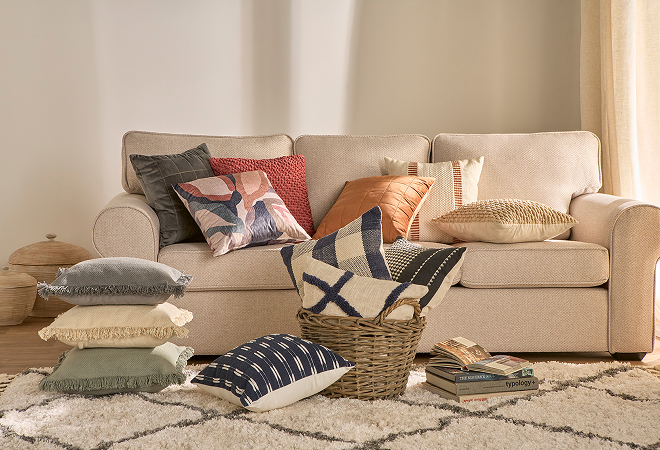
How to style your sofa with cushions and throws
Small changes can make a huge difference to how your living room feels. The key is thinking about balance, colour and texture rather than just buying whatever catches your eye.
Colour coordinate
Most people think they need one or two bright accent pieces to make their room interesting. This could work, but it could also make your space feel a bit off.
Instead of choosing accent colours on a whim, start by looking at the colours that are already present in the room, such as your wall colour or the dominant colours in a piece of art.
This pulls your existing colours together while introducing new life to the room. Your cushions and throws become the bridge that connects your furniture, walls and accessories rather than standing out awkwardly.
Think about material
Your fabric choice should match how you actually use your living room. Beautiful but impractical fabrics become expensive decorations rather than functional accessories.
Ben emphasises the balance between beauty and practicality: “A stylish, minimalist throw pillow in a beautiful silk might dazzle, but if it's too delicate to be used daily, it's decor rather than utilitarian design.”
For busy households, cotton-linen blends and densely woven wool handle daily use better than delicate fabrics. Velvet adds luxury but requires more careful maintenance. Machine-washable options work well for families with kids or pets.
Mix textures
Mixing different textures is a great sofa styling hack — it adds that bit of contrast without having to add colour if that’s not your thing.
Ben Harvey shares one way to do this with pillows and throws: “Pair a smooth silk pillow with a nubby wool throw for contrast.”
Begin with the texture of your sofa and build from there. A fabric sofa pairs effortlessly with a variety of textures, such as velvet cushions or knitted throws. In contrast, a leather sofa complements the soft, breathable nature of linen, adding balance and elegance.
For extra comfort and visual interest, layer a suede pillow with a cozy wool throw to create a tactile contrast that invites relaxation and enhances the overall aesthetic.
Your best bet will be to try things out in person — most texture combinations can work if they’re also complementary colours and patterns.
Choose complementary patterns
Pattern mixing feels intimidating, but follows simple rules — different scales and shared colours are what make them work together.
Fedzianiova Textile Decorator and Interior Design Expert Sviatlana Fedzianiova breaks down the scale approach: “Don't make all your cushions have a large pattern or a small pattern. Mix different scales — maybe one cushion with a large floral pattern, one with medium geometric and one with small texture or stripe.”
If your patterns share at least two colours from your existing room palette, they'll usually work together. Start with one patterned cushion and build from there rather than trying to mix multiple patterns straight away.
Get the cushion number right
Too few cushions make your sofa look empty. Too many make it annoying to sit on.
Fedzianiova suggests basing your number decision on the size of the sofa:
“For a standard 3-seater sofa, you need a minimum of five cushions in different sizes. For sectional sofas 200cm or more, you need 7–8 cushions for it to look proportional and feel comfortable.”
Odd numbers work better than even numbers for a natural, relaxed look. Three or five cushions on a standard sofa feel more organic than perfectly paired arrangements.
Style your cushions and throws
How you place your sofa extras can make a big difference. Blankets piled up in a mess never look good. Perfectly lined-up cushions look staged and uninviting.
Sviatlana suggests a more natural approach: “Don't line them up like soldiers. Angle some cushions, let them lean naturally. Place larger cushions in corners and smaller ones toward the centre.”
For throws, Ben recommends varying the styling: “Drape one sloppily across an arm of a sofa or fold neatly across the seat for a fitted appearance. A second throw, perhaps of differing texture, can fall over a chair or ottoman to sew the room together.”
Quality vs budget considerations
With pillows and throws so widely available, it can be tempting to stock up on the cheapest option you can find. But cheap cushions and throws can actually make your living room look worse, especially when they start falling apart.
Ben shares his favourite materials for cushions and throws: “High-quality materials, like handwoven wool throws or down-feather cushions, offer long-term sturdiness and luxurious texture that will never be replicated by cheaper options.”
“Quality zippers and strong stitching keep fraying away and preserve longevity.”
You don't need to spend a fortune, but investing in a few quality pieces works better than buying lots of cheap options.
Shop cushions and throws at Fantastic Furniture
At Fantastic Furniture, our cushion and throw range includes something for every style and budget. We’re committed to giving you quality pieces that will last you years.
Visit us in-store to see and feel out some options, or shop our accessories and decor online to see our full range.
Throws and cushions on sofa FAQs
My sofa is grey — what colour cushions should I get?
Grey is super versatile. You can go warm with terracotta, mustard or blush pink, or cool with navy, sage green or cream. The world’s your oyster.
Should cushions match my coffee table or other furniture?
They don't need to match exactly, but they should complement your overall colour scheme.
Pick up accent colours from your coffee table, artwork or rug rather than trying to match wood tones or exact colours.
Different sofa styles need different cushion approaches too. For armchairs and single recliners, one statement cushion often works better than multiple small ones.
Sofa beds may do better with fewer cushions, so it makes converting to bed mode easier.
How often should I replace cushions and throws?
Quality pieces can last years, but you might want to change them out seasonally. Swapping between lighter and heavier throws or changing accent colours keeps your living room feeling fresh.
What's the best way to clean cushions and throws?
Check care labels after buying, especially for something like a wool throw. Removable, washable covers for cushions make maintenance much easier.